Tea Growing and Processing

 Tea begins with the bush, which is of the same family as the decorative Camellia. The full botanical name of tea is Camellia sinensis (L) O. Kuntze. Sinensis is Latin for Chinese where tea is believed to have originated; Lrefers to Carl von Linnaeus who developed the modern system of classification, while O. Kuntze discovered the linkage between tea bushes and Camellias.
Tea bushes are evergreen and tea bushes are pruned to the height of 150cm (5ft). It sends forth its green tender new leaves and buds in what are called flushes, and care and attention is needed to encourage the bush to flourish and produce a quality crop. The tea bush grows best between the latitudes of Cancer and Capricorn and at altitudes of 300m - 2100m (1000ft - 7000ft) above sea level. In its wild state, tea grows best in regions that are warm and humid, with a rainfall of at least 100cm (39 inches) a year. It likes deep, light, acidic and well-drained soil.
The volcanic soil often found at higher altitudes enhances quality; the best Assam, Ceylon and Darjeeling teas are high grown in the cool, fresh conditions above 1220m (4000ft), while low grown varieties have to endure heavy soils and warmer weather. In a cold climate, like the Himalayas, bushes lie dormant in the winter, sprout in spring and grow throughout the summer, but in semi-tropical Sri Lanka (Ceylon) and Africa, they can be plucked all year around, with exceptionally high yields during the monsoon season.
FROM SEEDLINGS TO CLONES
Until fairly recently, tea bushes were grown from seed and planted out in a distinctive swirling pattern up and down the hillside.
Once established (taking about 10 years), a tea bush can thrive for 80 years with one hectare producing on average 1000kg (2200lb) of leaves per season, but producers had little control over plant quality. However, in the 1970s, vegetative propagation (or cloning) - where strong branches are pruned from a "mother bush", cut into short lengths of twig and single leaf and rooted - meant that only the healthiest tea bushes were used.
Careful selection for taste of tea rather than tea yield, resistance to disease, or increased hardiness is the hallmark of gourmet speciality tea producers at this stage. For volume-driven tea producers, yield is the primary selection requirement and cloned bushes were then planted in long, evenly-spaced rows across the hillside; in a good mountain region, a hectare of clonal tea bushes can now produce 3500kg (7700lb or 3.4 tons) a year.
The other advantage of this method of tea planting is that strong horizontal planting binds the soil and prevents it being washed away during the torrential rains of the monsoon. As part of land improvement, larger trees are planted every fifth row to provide shade and cover for birds, and foliage from pruning is laid between the rows to help moisture retention, thereby boosting yield and improving the quality of the land.
TRAINING THE TEA BUSH
The tea bush - when left to its own devices - will grow into a fairly substantial tree. Indeed, in much of China, this is how traditional tea was, and is, grown, and in tea plantations there are often some tea bushes that are allowed to grow into trees for the purpose of growing seeds.
For tea production, it is necessary to train the tea plants into bushes. Great care is taken to create a shape that aids consistent plucking. This is called bringing into bearing, or frame formation, and is carried out through pruning and sometimes pegging. Pegging is the bending down and pegging of some branches into position. The result of successful pruning and pegging is a relatively flat, consistent surface of trained tea bushes, the plucking table.
Repeated plucking of the new growth on the plucking table eventually results in a growing surface that is heavily congested by old stems. These need to be cut out regularly either by skiffing - a cut at only the highest level which allows new growth and so new plucking to return quickly - or maintenance plucking - this is a deeper cut that lowers the plucking table down to a more convenient height for people doing the plucking.
Maintenance plucking is then often followed by tipping. Tipping involves leaving 15cm (4 inches) of stem and plucking over it. This process increases the number of branches which will produce fresh points for plucking and helps to produce a flat table for plucking.
THE ART OF PICKING
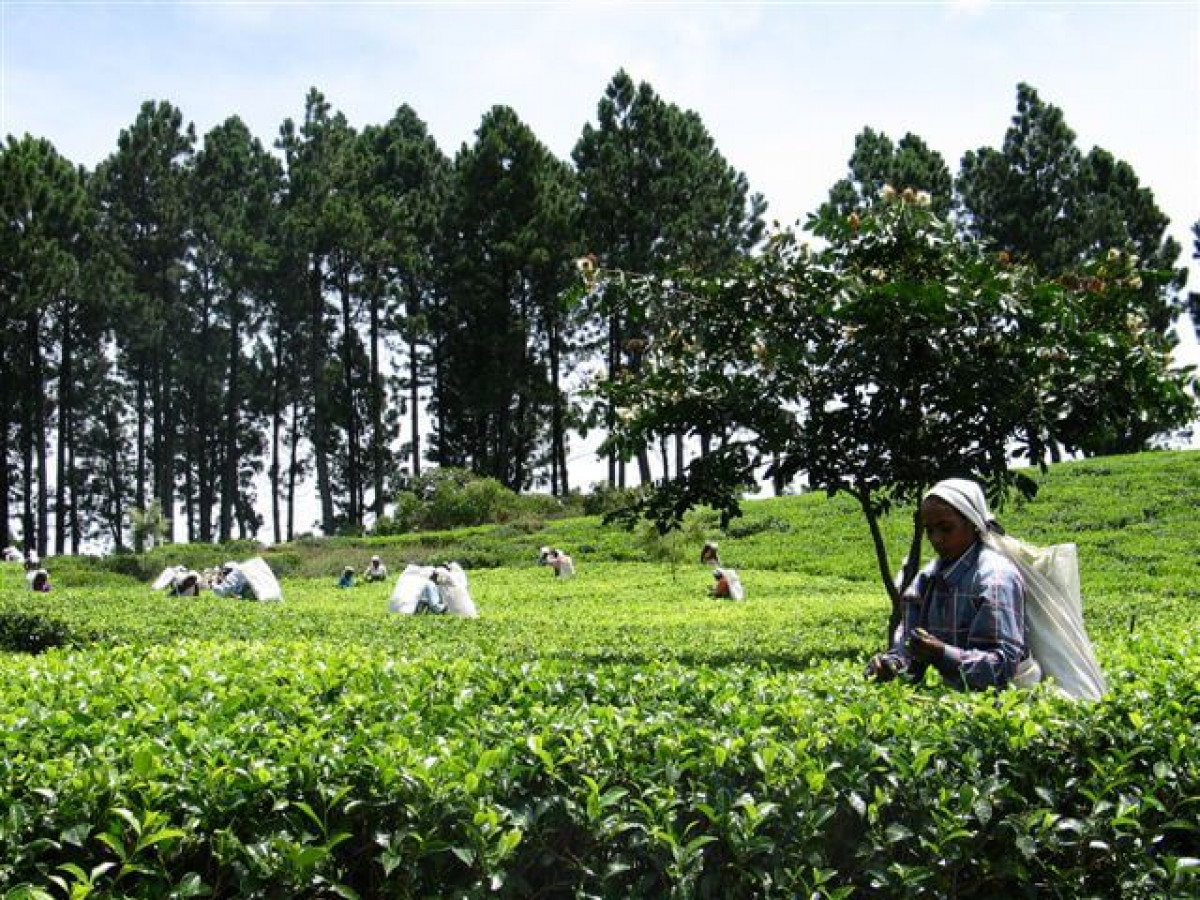
Even in the 21st century, tea picking is a labour intensive business. Hand selection of the best "Tip and Bud" is essential to maintain the superior quality of the fine, high-grown teas, and furthermore, it would be impossible to drag machinery onto the steep hillsides.
The tea pickers (usually barefoot) move deftly through the bushes, wearing company aprons or jute sacks over their saris to protect them against any twigs. In Assam, in particular, they carry black umbrellas as sun shades for themselves or their children. Tea pickers also carry long bamboo canes, which are laid on top of the bushes to help them pick a level, sometimes so evenly that a field looks like a billiard table.
At the peak of the season, an experienced tea picker can harvest up to 35kg of green tea per day, sufficient to produce 9kg of processed black tea. Even in these days of equality, women are considered more nimble-fingered and therefore more efficient at picking, while men work the land and process the leaves in the factory. In less hilly areas, and on the African plains, some teas are picked mechanically, using giant cutters dragged over the bush tops by a couple of men. It may not be selective but it is efficient - with a good rainfall the harvest can be 4500kg (9680lb or 4.3 tons) per hectare per year.
THE EQUIPMENT
The sheer volume of tea being produced in India required a colossal labour force and the greatest revolution in the tea industry was the invention of machines to process the freshly picked leaves. In 1870, the Jackson Brothers designed the first steam driven rolling machines, which were established by the long-established English firm of Marshall & Son. Until then, all the rolling, sifting, grading and drying of leaves had been done by hand, and the tea chests were packed down barefoot. The new machines, as well as freeing thousands from menial tasks and increasing output, also standardised methods of production. Tea could now be picked, processed and packed efficiently, ensuring maximum output and consistent quality.
PROCESSING THE FRESH LEAVES FOR BLACK TEA
The first stage of processing is called withering. The fleshy green tea leaves are laid on huge trays and dried with hot air (25 - 30°C) to reduce excess moisture, which takes 10 - 16 hours. These dried tea leaves are then rolled in a large rotary drum, breaking up the leaves and releasing the natural enzymes which start fermentation (oxidisation), which takes 3 - 4 hours. At this stage, the leaves start to lose their green colour, turning the more familiar coppery brown known as Orange Pekoe (or orange coloured leaf).
Pekoe tea is the anglicised version of the Chinese Pak-ho which means white hair or down and now denotes a particular leaf size of tea from any origin but thanks to Sir Thomas Lipton's agressive promotion of Orange Pekoe Tea many people (even today) think it is type of tea.
As the skilfully-controlled fermentation process continues, it is stopped by drying before the leaves become too black and plain, then the tea leaves are rolled into tight twists and graded. There are 2 methods of processing.
The traditional way, known as Orthodox, keeps the look of the leaf whatever its size and is used for all China, Darjeeling and most Ceylon and about 10% of Assam teas. In the modern manufactured method, the leaf is Cut, Torn and Curled (hence CTC Teas) rather than rolled, producing strong black balls of tea which release a very strong flavour and colour. It is ideal for small, strong leaf teas which are needed to flow easily through packing and tea bag machines.
Green teas & oolongs are non-fermented teas, i.e. the tea leaves are picked and allowed to dry in the sun in bamboo baskets for a few hours. The tea leaves are then pan-roasted and finally rolled into attractive shapes that provide pleasure from the leaf before, during, and after the tea is brewed. These tea leaves range from bright to dull green and are pliable.
In Japan, green tea is steamed and processed into different forms, including powdered green tea or matcha, which is still used today in Japanese tea ceremonies. In Japan, there are 3 grades of green tea: bancha, sencha, and gyokuro. Bancha tea is Japan's ordinary green tea. It comes from the late summer pickings and is somewhat coarse in flavour and appearance. Sencha is one step up and comes from the first or second flushes. The tea is steam-fired and basket-dried and finally hand-rolled. This process is more costly. Sencha gives off a grassy aroma and is pale in colour. Gyokuro tea is harvested once a year and only the bid and tiny first leaf are plucked. This process means precious dew. This tea brews to give a very pale green to yellow colour and has a clean brisk flavour.
Oolong teas are semi-fermented, partially withered and partially oxidised. China and Taiwan are the main producers of this type of tea. Leaves for oolong must be picked at exactly the right time and processed immediately afterwards. They are withered in direct sunlight, then shaken in bamboo baskets to bruise the edges of the leaves which turn a reddish-brown colour after oxidation has occurred. This process is repeated a few times. Oolong tea leaves are never broken by rolling as in green teas or by machines with black tea, and they should always be long and whole leaves.
GRADING THE TEA
Leaf size is an important indicator of quality and strength, but whatever the size, all leaves should appear even, neatly made and free from dust. The very best tea comes from the Tip and Bud, where all the sap and energy of the bush are concentrated to achieve new growth. Grading terminology, which applies only to Orthodox teas, can seem almost comical to the layman, but it conveys a great deal to the connoisseur:
Special Finest Tippy Golden Flowery Orange Pekoe (SFTGFOP) is simply the best; 10 - 15 mm twists with plenty of tip and a smooth, luxurious taste.
Tippy Golden Flowery Orange Pekoe (TFGOP) and Flowery Orange Pekoe (FOP) refer to long twists of large leaf tea with a generous amount of tip and a superior smooth taste.
Orange Pekoe Tea (OP) is a large leaf tea with whole rolled leaves, but not tippy.
Pekoe Tea is a smaller grade of tea leaf, moderately neat. The liquor has more colour than OP, but not the smoothness of flavour.
Golden or Flowery Broken Orange Pekoe Tea (G or FBOP) is a neat, square tea leaf of 1 - 2 mm with plenty of pale tip; a sign of solid quality and strong taste.
Broken Orange Pekoe Tea (BOP) is a smaller tea leaf with good strength and a neat, dust-free appearance. Many everyday teas are BOP and offer good quality, colour and flavour.
Broken Orange Pekoe Fannings Tea (BOPF) and Dust are Orthodox tea leaves intentionally rolled and sifted small. It is consumed in local markets or for tea bags.